What the Martingale System Is
Martingale is a negative progression betting system that grew out of eighteenth-century French gambling halls. It is applied to bets that pay 1 to 1, which in roulette means red, black, odd, even, 1-18 and 19-36. The rule is simple. Place a base bet. If it wins, place the same base bet again. If it loses, double the previous bet and place it on the same even-money outcome. Continue doubling after each loss until a win occurs, at which point the sequence resets to the base bet and one base bet of net profit is locked in.
How the Progression Works
Each step doubles the previous step. A $10 base bet becomes $20, $40, $80, $160, $320 and so on. The cumulative amount risked at any step is the sum of all previous bets plus the current one. After six consecutive losses on a $10 base bet, total exposure is $630 and the next required bet is $640. The exponential growth of the stake is the source of both the system's apparent strength and its real fragility.
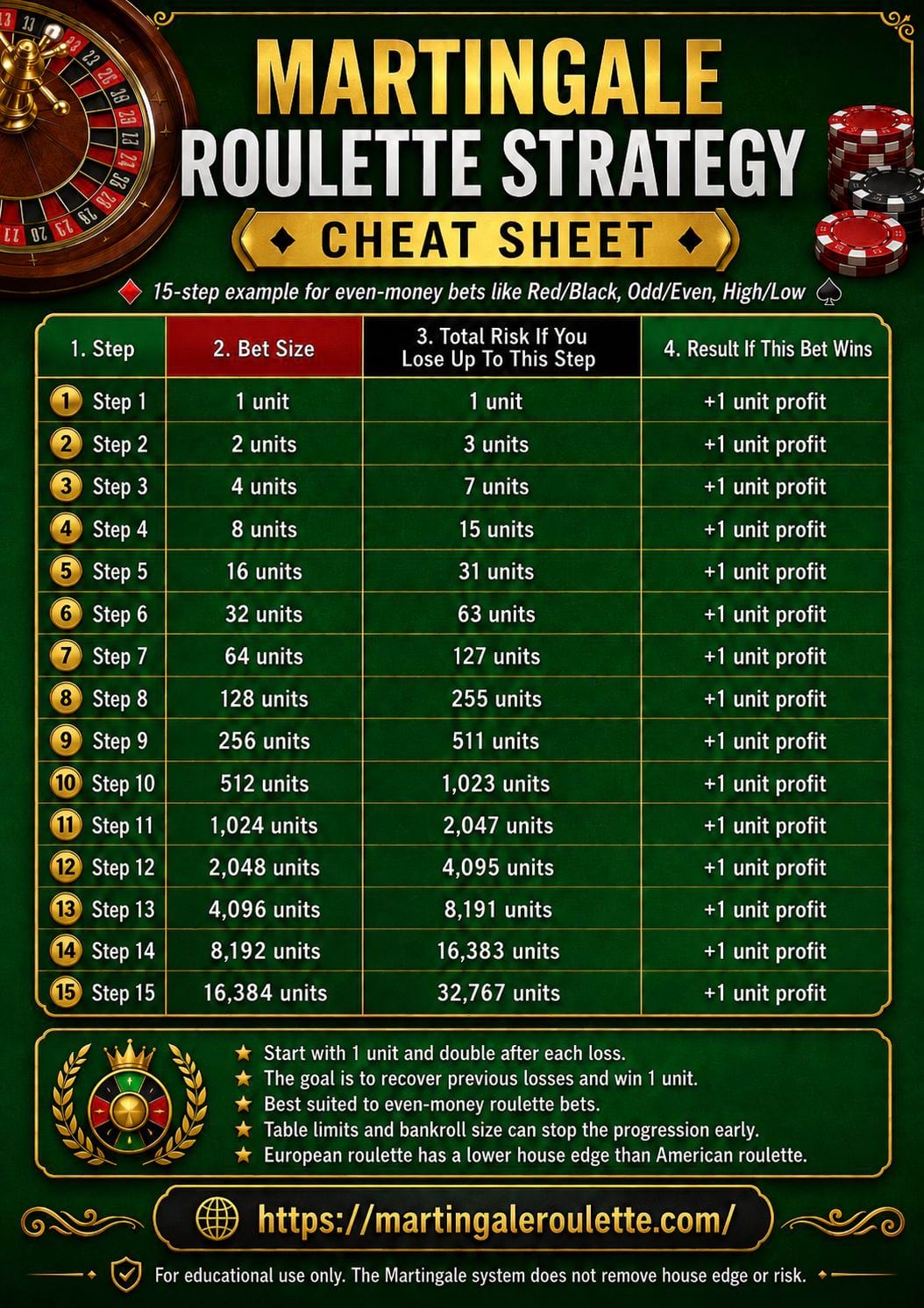
Click the image to download full version of the cheat sheet or download the Martingale Strategy PDF here.
Example Betting Sequence
Imagine three losses followed by a win on red, with a $10 base bet. Bet one of $10 loses. Bet two of $20 loses. Bet three of $40 loses. Bet four of $80 wins, returning $160 to the player. Total wagered across the four bets is $150. Profit on the sequence is $10. The pattern always produces a one-unit profit when a win finally arrives, regardless of how deep the losing streak ran, provided the bankroll could fund every step.
Why Martingale Looks Attractive
Two features make the system feel safe. First, the win probability on each even-money roulette bet is close to 50%, so a losing streak of more than five in a row feels unlikely to a casual observer. Second, most short sessions end in profit because the base bet wins on the first or second step the majority of the time. The combination of high local win rate and small per-sequence profit creates the false impression that the system reliably grinds out wins.
Why Martingale Does Not Change Roulette Odds
The wheel does not know how much money is on the table. Every spin is an independent random event with the same probabilities. Doubling the stake after a loss only changes the dollar amount at risk on the next spin. It does not change the proportion of red and black pockets, it does not eliminate the green zero, and it does not raise the probability of red after a long run of black. Any belief that black is "due" after several reds is the classic gambler's fallacy.
Even-Money Bets and Why They Matter
Martingale only works mathematically on bets that pay 1 to 1, because the doubling logic depends on a winning bet covering exactly the previous total loss plus one base bet. The eligible bets on a roulette layout are red, black, odd, even, 1-18 and 19-36. Each covers 18 of the 37 pockets on European and French wheels, and 18 of the 38 pockets on American wheels. The green zero or zeros are the source of the house edge on all of them.
European vs American Roulette in Martingale
European roulette gives Martingale its best theoretical chance because the win probability per spin is 48.65%. American roulette drops the same probability to 47.37% thanks to the double zero. Across many spins this small gap accumulates into a sharp difference in expected loss, because the house edge rises from 2.70% to 5.26%. French roulette uses the European wheel and can offer La Partage to reduce even-money edge further, but that rule is not universal.
Losing Streaks: The Real Risk
A losing streak of six on an even-money roulette bet has roughly a 1.5% probability on a European wheel. That sounds small, but in a session of 200 spins a streak of six losses is common, and a streak of seven appears regularly. Each additional loss doubles the required bet and the cumulative exposure. Long sessions experience these streaks routinely. Martingale only collapses when one arrives, and it always eventually arrives.
Table Limits Make the Problem Concrete
Real casinos enforce maximum bets on every table. Even at high limits, table maximums are typically a few hundred multiples of the table minimum. Once the doubling progression reaches the table maximum, the system cannot legally continue and the next loss is permanent. Table limits exist precisely because casinos understand that without them Martingale could theoretically force a small recovery, with them the system is mathematically locked into eventual failure.
Bankroll Limits Are Just As Strict
Even when a table limit is not the issue, the player's own bankroll defines a hard ceiling on the progression. The Martingale calculator on the homepage makes this visible by listing only the steps that the bankroll can fund. Once the next doubled bet exceeds the remaining funds, the sequence ends and every previous loss in that sequence becomes permanent.
Risk of Ruin and Why It Grows With Targets
The risk of ruin for a single Martingale sequence is low when the bankroll allows many doubling steps. But sessions are made of many sequences, and the probability of completing all of them without hitting a deep losing streak multiplies down quickly. Doubling the target profit more than doubles the risk of ruin because each additional required win adds another independent failure chance.
How to Use the Calculator and Simulator Together
Start with the Martingale calculator to see the theoretical progression and risk numbers for a chosen base bet, bankroll and target. Then open the strategy simulator and run many sessions with the same inputs. The simulator shows real variance and lets you compare Martingale against flat betting, D'Alembert, Fibonacci, Paroli and other systems on the same wheel.
Responsible Gambling and the Limits of Theory
Educational use of Martingale is fine. Real money use to chase losses is the most common path to serious gambling harm because the system feels safer than it is. The responsible gambling page contains external help resources and the basic rules for using any betting system without putting yourself at risk. Treat the math as math.
For a more advanced example of how high table coverage and recovery staking can interact, see the Shauna + Romanovsky Hybrid Martingale Simulation.
For more depth, see whether Martingale actually works, which are the best bets for Martingale, how to plan a session strategy, the common mistakes to avoid, and how Martingale fits among all roulette systems.